How We Give Claude Access to Real-Time Data
By combining Anthropic's Model Context Protocol with real-time structured web data powered by Supergood integrations, we dramatically improve the accuracy and usefulness of LLMs.
If you've ever tried to get an LLM to accurately utilize data from the web, you'll know the struggle.
Ask it to find menu prices from Chicago restaurants and you'll get a wall of text about Lou Malnati's famous deep dish instead of a clean table of restaurants, prices, and items.
We've been working with Claude to tackle this problem, and we've found that by combining Anthropic's Model Context Protocol (MCP) with real-time structured web data powered by Supergood integrations, we can dramatically improve the accuracy and usefulness of LLMs.
LLM + Web Data: Great for demos, not for scale
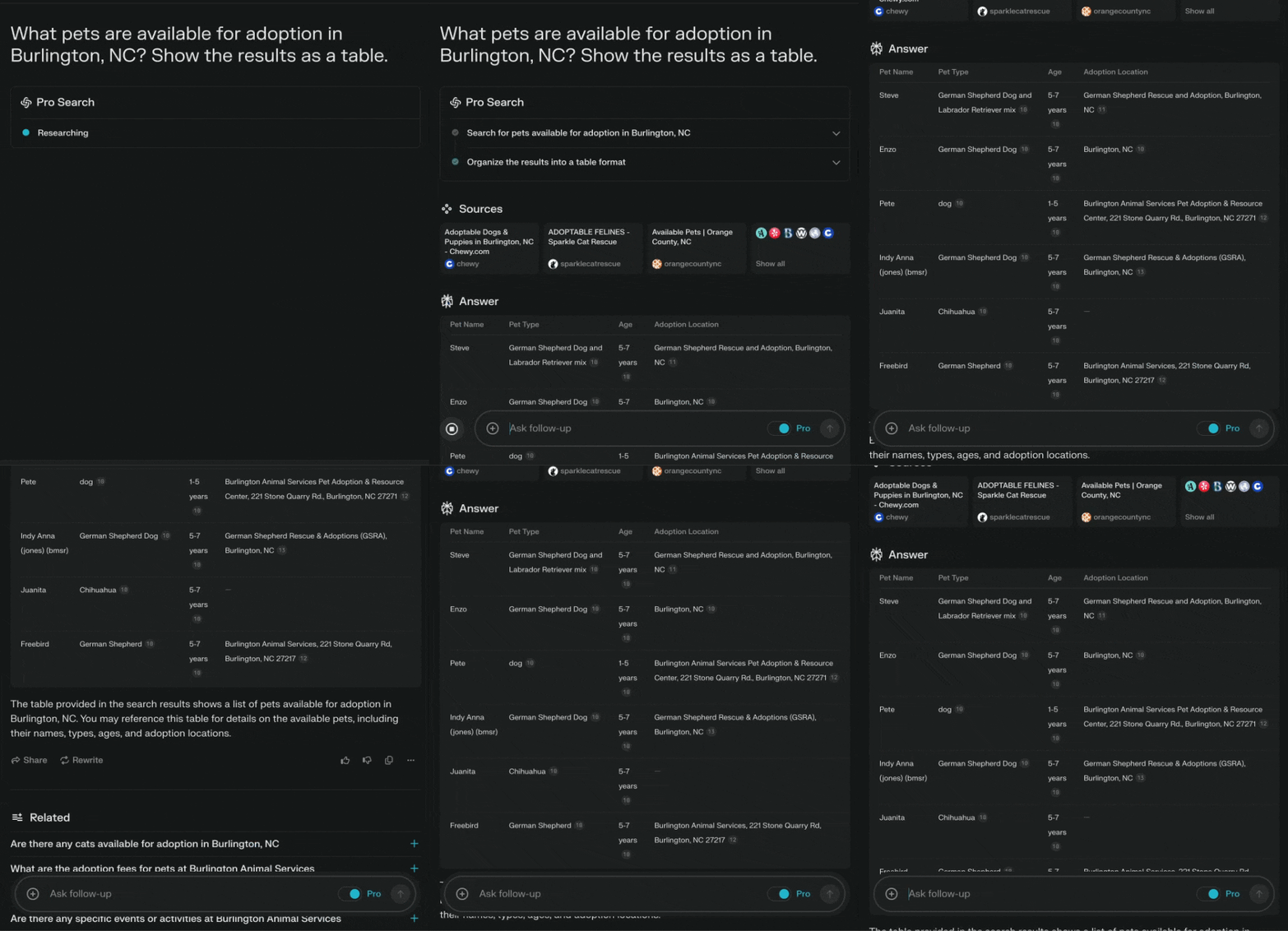
Ask a tool like Perplexity to find pets available for adoption in Burlington, NC, and the results look fine at first glance. They're actually sparse and inaccurate: dozens of adoptable animals never show up.
For teams building products at scale, a consumer LLM subscription isn't enough to pull reliable web data into an application.
Solving the scale problem requires better tools
Using Anthropic's MCP with Supergood-generated tools produces striking improvements:
- Full control over data sources: Models prioritize high-quality structured datasets unavailable to off-the-shelf LLMs
- Search across massive datasets: Rather than cramming unstructured data into context windows
This extends beyond RAG applications and is a hard truth about LLMs: they work way better when they have access to structured data.
MCP bridges the gap between models and tools
MCP is Anthropic's protocol for standardizing how models interact with external tools. It functions as a universal adapter enabling models like Claude to connect directly to specialized tools while maintaining consistent output formats.
Once tools implement MCP, any model supporting the protocol can use them, promoting better long-term interoperability across the AI ecosystem.
Structured, real-time web data: AI's killer power tool
Perplexity excels at providing humans quick web answers, but production AI applications require fundamentally different approaches. The challenge involves maintaining reliable data pipelines that deliver consistently high-quality output while handling modern web application complexity.
Supergood generates "unofficial APIs that are officially maintained." The platform combines LLMs with proprietary observability data and human-in-the-loop expertise to ensure high-quality, structured data delivery, allowing AI applications to utilize real-time web data without requiring dedicated engineering resources.
See it for yourself
MCP has matured fast since we wrote this, but its potential with reliable web data is evident. If your team is experimenting with AI agents and tools, we'd love to show you what's possible. Reach out at hello@supergood.ai.
Related reading
- WTF is MCP?: a plain-English explainer of the protocol
- MCP for software without a public API: how MCP servers get built when the platform never shipped an API
FAQ
What is MCP?
MCP (Model Context Protocol) is Anthropic's open protocol for standardizing how AI models interact with external tools. It works like a universal adapter: once a tool implements MCP, any model that supports the protocol can use it, which is why we build Supergood integrations as MCP tools.
Why do LLMs need structured data?
LLMs work far better when they can query structured data than when they parse walls of unstructured text. Real-time structured sources let a model search across large datasets instead of cramming everything into its context window, which makes the output dramatically more accurate in production.