Blog
Insights on unofficial APIs, agent tooling, and enterprise automation from the Supergood team.
All Posts

voice agents
The Voice Agent Latency Budget: How Fast Does a Tool Call Need to Be?
A voice conversation gives a tool call a fraction of a 500ms-to-1s turn budget after speech recognition, the LLM, and speech synthesis take their share. The numbers, where browser automation loses them, and the patterns that fit: direct backend calls, prefetch on ring, and acknowledge-and-callback.
automation maintenance
Why Your Enterprise Automation Keeps Breaking (And What to Do About It)
A diagnostic guide for automation that keeps failing: selector drift after portal redesigns, MFA walls, and UI-layer latency that compounds at volume. Covers Selenium, Playwright, Puppeteer, UiPath, Power Automate Desktop, and Automation Anywhere, with a routing table from symptom to fix.

selenium
Why Does My Selenium Scraper Keep Breaking?
NoSuchElementException after a site update, StaleElementReferenceException on dynamic pages, ChromeDriver version mismatches, CAPTCHA walls: a diagnostic for every recurring Selenium failure, with an error-to-fix routing table and the maintenance math that decides when to stop patching.

playwright
Why Does My Playwright Automation Keep Failing?
Playwright TimeoutError on locators, net::ERR_ABORTED on auth redirects, headless detection, rate limiting, MFA walls, and locator drift after a portal redesign: a diagnostic for each failure, with routing table and the yearly maintenance math per portal.

puppeteer
Why Does My Puppeteer Script Keep Breaking?
Puppeteer navigation timeouts, headless detection by Cloudflare and DataDome, CAPTCHA walls, selector drift after site updates, Chromium version rot, and the memory math at 10k+ monthly runs: a diagnostic for each failure with an error-to-fix routing table.

rpa
Why Does My RPA Bot Keep Breaking (And What To Do About It)?
Selector drift after portal updates, surprise MFA walls, per-step latency that compounds at volume, and licensing that scales against you: the failure modes shared by every RPA platform, with a routing table and the 12-month cost math for one portal integration.

uipath
Why Does My UiPath Bot Keep Breaking After Every Portal Update?
UiPath selector drift after portal redesigns, ReFramework dispatcher/performer failures, MFA walls, Orchestrator concurrency limits, and the licensing-times-latency math at 10k+ monthly runs: a UiPath-specific diagnostic with routing table and 12-month cost example.
power automate
Why Does My Power Automate Desktop Flow Keep Breaking?
UI element selector failures after portal updates, SAP GUI struggles, Conditional Access blocking unattended flows, per-step latency, and the licensing maze of attended vs hosted machines: a Power Automate Desktop diagnostic with routing table and cost math.

automation anywhere
Why Does My Automation Anywhere Bot Keep Breaking?
A360 object-cloning errors and selector drift after portal updates, CAPTCHA and bot-detection walls, MFA surprises, Control Room concurrency limits, and consumption pricing at volume: an Automation Anywhere diagnostic with routing table and 12-month cost math.
reference-guide
Connect Zapier, Make, and n8n to Legacy Enterprise Platforms
Your no-code tool says no connector available. An independent reference for which legacy enterprise platforms Zapier, Make, and n8n can reach, which they cannot, and what connecting the rest through a generated API could look like. Compatibility matrix plus step-by-step flows.
mcp
MCP Servers for Software Without a Public API: The Complete Guide
Scraping MCP servers, browser-automation MCP servers, and private-API MCP servers all promise agent access to software without a public API. How the three approaches differ on latency, reliability, and writes, and which one holds up in production on enterprise portals.
rpa
The Best Automation Tools for Enterprise Portals: A Ranked Buyer's Guide (2026)
Ten automation tools, UiPath, Automation Anywhere, Power Automate, Zapier, Make, n8n, Skyvern, Playwright, Selenium, and Supergood, ranked by what they're actually for. Start with the routing table: the right tool depends on whether you're automating a desktop app, a connector-covered SaaS, or a web portal with no API.

retell
Give Your Retell AI Agent Access to Any Portal (July 2026)
Retell agents handle the conversation; the business systems hold the answers. How to connect a Retell agent to portals with no API, at voice-grade latency. Updated July 2026.

vapi
Give Your Vapi Voice Agent Access to Any Portal (July 2026)
A Vapi agent is only as useful as the systems it can touch mid-call. How to give it real-time access to portals with no API, at voice-grade latency. Updated July 2026.
workato
Supergood vs Workato for Systems With No API (July 2026)
Workato is a top enterprise iPaaS, and its recipes are excellent when APIs exist. For the vertical portal that has none, here's how the two layers fit. Updated July 2026.
make
Connect Make to Software Without an API (July 2026)
Make's HTTP module can call any API. For the portal that has none, a generated backend endpoint slots into your scenario as one more module. Updated July 2026.

n8n
Connect n8n to Software Without an API (July 2026)
n8n's HTTP Request node can call anything with an API. For portals that have none, a generated backend endpoint makes them a node like any other. Updated July 2026.
zapier
Supergood + Zapier: Automating the Systems Zapier Can't Reach (July 2026)
Zapier connects 7,000+ apps that have APIs. Your industry's core system probably isn't one of them. How to wire the no-API portal into your zaps. Updated July 2026.

ipaas
What iPaaS Can't Reach: Integrating Software That Has No API (2026)
Zapier, Make, Workato, MuleSoft, and Boomi connect software with APIs. Most vertical software has none. How the two layers fit, and what covers the gap.

uipath alternatives
UiPath Alternatives for Automating Software Without APIs (2026)
The honest UiPath alternatives for no-API systems: Power Automate, Automation Anywhere, n8n, Make, Zapier, and managed backend APIs, each with where it wins.

rpa
RPA vs API Integration: A Decision Guide (2026)
Five questions that route any automation project to the right tool: RPA bot, browser agent, no-code connector, or a backend API. Vendor-neutral until the very end, with the failure modes of each path spelled out.
power automate
Power Automate Alternatives for Software Without an API (2026)
Power Automate is excellent when connectors exist. When a portal has no connector and no API, UI flows carry a maintenance tax a managed API removes. Updated July 2026.

uipath
Supergood vs UiPath for Portal Integration (July 2026)
UiPath is the most mature RPA platform. For web portals with no API, a managed backend API removes selector maintenance and per-bot infrastructure. Updated July 2026.

api discovery
Does My Software Have an API? How to Find Out (and What to Do When the Answer Is No)
A 20-minute diagnostic for checking whether any software platform has a usable API, what 'partner API' really means, and your options when there isn't one.

no api
How to Automate Software That Has No API (July 2026)
Five ways to automate a system with no public API, compared honestly: partner programs, no-code connectors, RPA, browser agents, and managed backend APIs. Updated July 2026.

browser automation
The True Cost of Browser Automation Past 10,000 Calls a Month
Browser automation cost at scale: the unit economics of headless browsers vs a network API, with a worked cost table from 10K to 1M calls a month.

voice agents
Why Browser Automation Is Too Slow for Voice Agents
Voice agent browser automation blows the conversational latency budget. Why a browser tool call kills a phone call, and what fits inside a spoken turn.

playwright
Handling MFA in Playwright: Workarounds vs a Real Fix
Handling Playwright MFA: real TOTP, storageState, and OTP-polling workarounds, plus why some MFA can't be automated and a maintained API fixes it.
browser automation
Supergood vs Browser Automation: The API Alternative Explained
An API alternative to browser automation: how Supergood replaces headless browsers with network-layer APIs for lower latency, cost, and maintenance.
playwright
Supergood vs Playwright: APIs vs Browser Automation for AI Agents
A Playwright alternative for AI agents: why network-layer APIs beat browser automation for high-volume, production access to third-party portals.
rpa
Supergood vs RPA: Why Enterprises Are Replacing Bots with APIs
A technical RPA alternative: how Supergood replaces UiPath-style bots with backend APIs to cut maintenance cost and stop UI-redesign breakage.
selenium
Supergood vs Selenium: Replacing Legacy Browser Automation with APIs
A Selenium alternative for production AI-agent access to third-party portals: why a maintained API beats driving a real browser via WebDriver at scale.
antibrowser
Browser Automation Doesn't Scale
Browser automation is great for demos. For enterprise workflows running millions of actions a month, it’s slow, brittle, and shockingly expensive.
agentic ai
What Is Agentic AI?
Agentic AI is AI that plans, calls tools, and gets work done across your systems. What it is, how it differs from generative AI, what it needs to be reliable, and where Supergood fits.

api
Connecting General-Purpose Document Management to Your Legal Stack
Not every law firm runs iManage. Plenty of legal teams run on SharePoint, OpenText, DocuWare, M-Files, Laserfiche, or Box, and connecting those platforms to CLM, e-signature, and matter management is where legal workflows break.

legal case management
Integrations Are the Real Differentiator in Legal Practice Management Software
If your product can natively read from and write to the practice management system a firm already lives in, you reduce friction to near zero: no duplicate data entry, no context switching, and no reason to rip out what's already working.

billing
Why Billing & Accounting Integrations Are Make-or-Break for Legal Software
Supergood builds custom APIs on request for legal software, including platforms like LawPay, Timeslips, Elite, Aderant, Intapp, and Tabs3 Billing, so firms and legaltech companies can connect their tools without waiting for official partnerships or building integrations from scratch.

caret legal
Why Document Management System Integrations Are Make-or-Break for Legal Tech
The DMS category has historically been slow to open up. Most enterprise DMS providers built their integrations through closed partnership programs, which means open, self-serve API access has been limited.

crm
Why Integrations Are the Backbone of Legal CRM Value: What It Means for Your Firm
If you're a law firm trying to connect your CRM to the rest of your stack, or a legaltech company that needs to integrate with the platforms your customers already use, Supergood builds the custom APIs, on request, to make that happen: fast, reliably, and without the overhead of building from scratch.
unofficial api
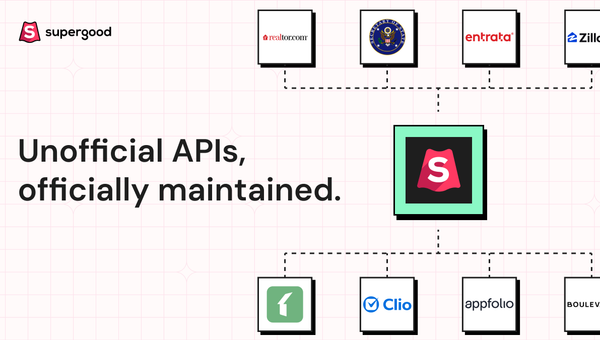
What Is an Unofficial API?
An unofficial API is a clean, documented way to read and write data from software that doesn't officially offer one. How they differ from scrapers and browser bots, why LLMs make them work at scale, and what makes one good.
mcp server
What Is an MCP Server?
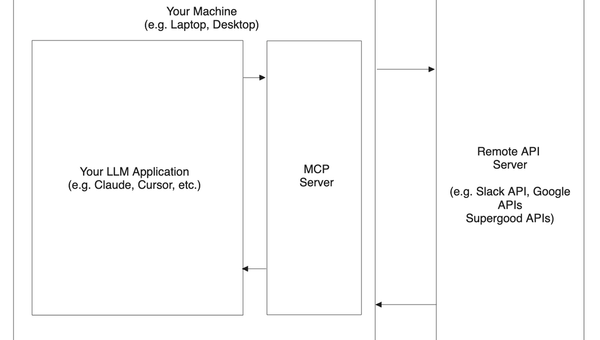
An MCP server is what lets AI models like Claude and ChatGPT actually use your tools. What it is, how it works, MCP server vs API, what you can plug in, and where it's headed.

MCP
How We Give Claude Access to Real-Time Data
By combining Anthropic's Model Context Protocol with real-time structured web data powered by Supergood integrations, we dramatically improve the accuracy and usefulness of LLMs.